





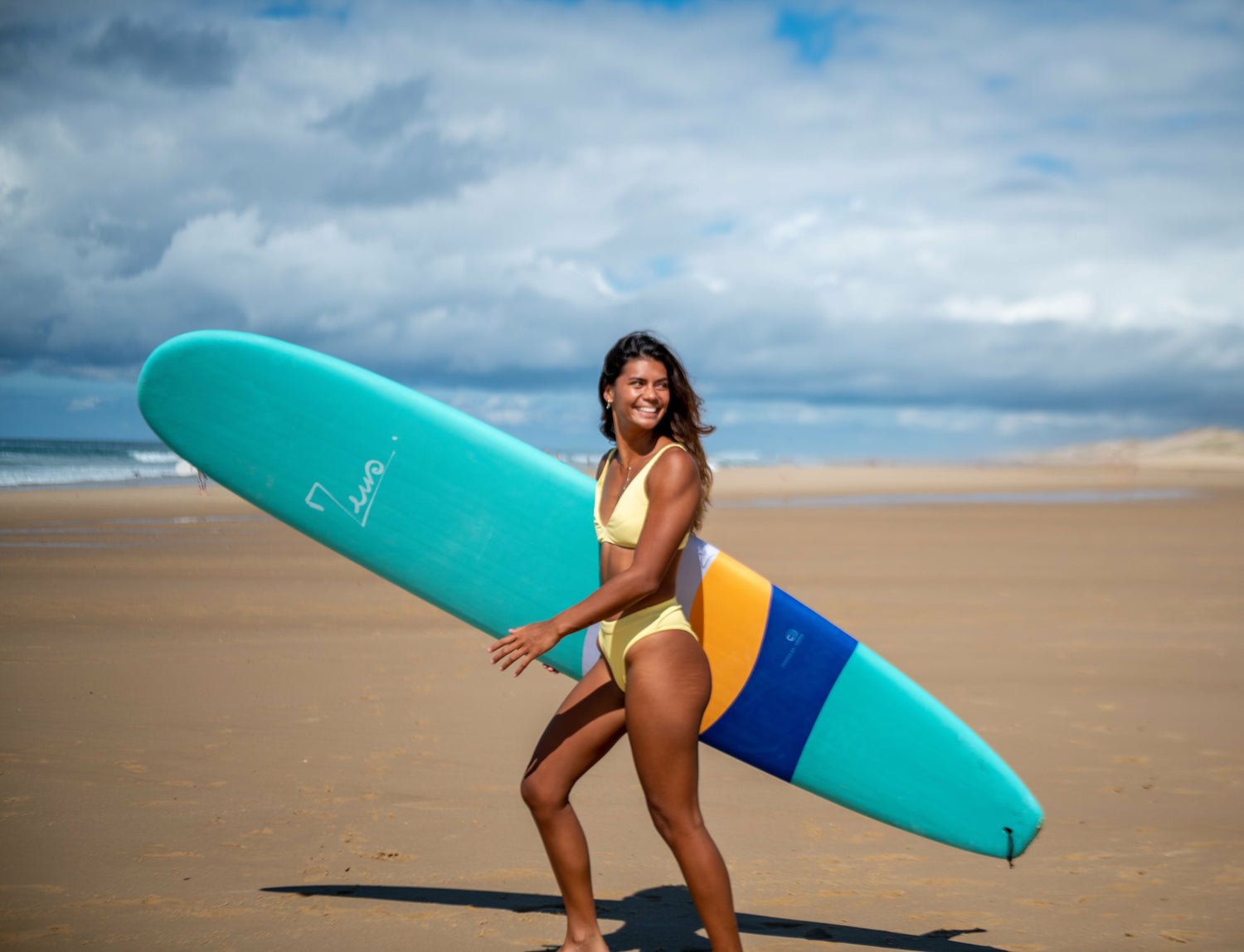
The ultimate guide to choosing your longboard.
Longboard surfing is more popular than ever. Many surfers, both beginners and experienced, are drawn to this type of board which is accessible, fun, and easy to master.
With a longboard, gone is the frustration of repeated falls on a shortboard when you're just starting out! Get ready for memorable sessions, unique glide sensations, and accelerated progress.
In this guide, we will detail everything you need to know to choose the longboard of your dreams, whether it's your first longboard or not.
So, whatever your level and goals, you'll find our valuable advice here to find the longboard that's right for you.
👉🏻 Find our selection of longboards on the online store 👈🏻
 A longboard is more than just a board; it's a state of mind. It transforms every outing into a friendly and relaxed experience. Perfect for sharing unforgettable moments with friends or family, it makes surfing child's play accessible to everyone.
Good reasons to get into longboard surfing:
Before going into detail about the criteria for choosing a longboard, let's start with a brief overview of the many advantages of this type of shape:
A shape accessible to beginners
Unlike shortboards, which are known to be difficult for novices to master, longboard surfing is suitable for all skill levels. Its greater length provides stability and buoyancy, allowing for a smooth learning curve. Even with little or no experience, it is entirely possible to stand on a longboard and quickly experience exhilarating sensations of gliding. It is THE board par excellence for starting and progressing quickly.
Exceptional glide sensations
Gliding is the very essence of surfing. However, few boards offer as pleasant a floating sensation as a longboard. The extended length of the board literally allows you to "fly" on the wave, with a very fluid feeling. The slightest wave movement is felt, for maximum pleasure with minimum effort. Pure sensations guaranteed!
Speed and control
Longboards often develop good speed, while remaining perfectly maneuverable. Where a shortboard requires anticipation and commitment, a longboard offers total control, allowing you to adjust your trajectory at will. The great stability also allows for simple, but so enjoyable, tricks like walking or dancing on the board.
Suitable for most spots
You can literally surf most waves with a longboard, whatever their type and power. High-volume longboards allow you to have fun even on small, gentle waves that would not be rideable with a shortboard. As for spots, they are suitable for most waves encountered in France and Europe.
A friendly surfing style
The longboard promotes a fun and relaxed approach to surfing. Its intuitive and accessible nature facilitates progress. Surfing with friends or family becomes child's play. It's a great way to share memorable sessions!
With all these advantages, it's no wonder that longboards are so popular. To choose the right one, you now need to consider the different selection criteria.
2. Longboard VS Shortboard
First and foremost, it is important to understand what primarily distinguishes the longboard from the shortboard, these two main families of boards.
The longboard is characterized above all by its length, generally between 8 and 10 feet (2.40 and 3m). This large dimension provides stability and buoyancy. The board can also be quite wide, with a high volume allowing it to float well, which is ideal for surfing small waves.
Conversely, a shortboard measures less than 7 feet (2.15m). Shorter, it will also be narrower and thinner. This makes it faster and more maneuverable, but also less accessible for beginners.
While the shortboard is designed for experienced surfers seeking thrills, the longboard offers control and balance, for a practice accessible to all levels. Its progressive learning avoids unpleasant surprises!
To summarize the essentials:
- Longboard: length 8-10 feet, great stability, accessible to beginners
- Shortboard: length < 7 feet, dynamic, demanding, thrills
Stability or thrills? That's what should guide your choice between longboard and shortboard!
3. The different types of Longboard
Longboards make up a large family that actually covers boards with very distinct characteristics. We can schematically distinguish 3 main types of longboard:
The Mini Malibu or Mini Mal
The mini malibu (sometimes spelled mini-malibu) is an intermediate longboard measuring from 7 to 8.6 feet. It can be said that these are smaller versions of longboards. These shapes are long enough to remain stable and accessible, yet the mini malibu remains maneuverable and versatile.
It's an excellent choice for those just starting out in surfing. The mini malibu also allows you to have fun on small summer waves. In short, it's an easy board for everyday use. This type of board, being more compact, is also easier to transport.
The Classic Longboard (Noserider)
This is the traditional longboard par excellence. Its generous dimensions, with a length greater than 9 feet and a high volume, make it the ideal board for beginners. The noserider is also perfect for the vintage style of surfing, with all the classic tricks on the front of the board. Stable and easy, it is however a bit limited when it comes to evolving on hollow and fast waves.
The Performance Longboard (HPLB)
The performance longboard or HPLB (High Performance Longboard) offers a completely different riding style. Often shorter (8'-9'), its refined outline and angular rails make this shape a real rocket, faster and more reactive. The HPLB is aimed at experienced surfers seeking more sensations and radicality. On this type of board, it is possible to link dynamic maneuvers and tricks like on a shortboard. Be careful, however, this gain in performance comes at the expense of accessibility and control.
Longboard Surf Types Comparison Table
| Longboard Type | Length | Characteristics | Ideal for |
|---|---|---|---|
| Mini Malibu (Mini Mal) | 7' - 8'6" | Maneuverable, versatile | Beginners, summer waves |
| Classic Longboard (Noserider) | > 9' | Stable, high volume | Beginners, vintage style |
| Performance Longboard (HPLB) | 8' - 9' | Fast, responsive | Experienced surfers, dynamic maneuvers |
4. What length to choose?
Regarding the sizing of the board, length is obviously the primary criterion to consider carefully.
For longboards, the length typically ranges from 8 to 10 feet. To choose yours, here are some simple guidelines:
- 8’6’’ (2.60m): recommended for lighter surfers (- 60 kg)
- 9’0’’ (2.75m): ideal for most surfers (60-80kg)
- 9’6’’ (2.90m): preferable for heavier surfers (+ 80kg)
These measurements are indicative. Don't hesitate to try boards close to these sizes to see what suits you best. On a longboard, you will prioritize stability and glide over maneuverability. It is therefore better to be cautious and go for a longer length.
To summarize, the lighter and more experienced you are, the more you can go down in size to gain dynamism. Conversely, if you are a beginner or strong, opt for a good length for stability and control.
If you already have some surfing experience, our article "Which surfboard for an intermediate level" could help you refine your choice.
5. What width to choose?
In addition to length, width is the second essential factor for board dimensions. For longboards, a typical width is generally between 20 to 23 inches (50 to 58 cm).
The wider the board, the more stability and buoyancy you will benefit from.
However, too much width will hinder speed acquisition and agility in turns. For maximum control, aim for a width of 20'' to 22'', depending on your build. Narrower longboards will be more suitable for lighter surfers looking to gain maneuverability.
6. What thickness to choose?
In addition to length and width, thickness completes the triptych of dimensions to consider for a longboard. Generally, it varies from 2 to 4 inches (5 to 10 cm).
Again, the thicker the board, the more buoyancy and stability you will gain. Conversely, a reduced thickness will allow for thinner rails and increased speed.
Specifically, for maximum versatility, aim for a thickness between 2''6 (6.5cm) and 3''1/2 (9cm). This will give you stability without making the board too heavy.

7. Outline and shape
Beyond simple dimensions, the general shape of the board will greatly influence its characteristics and performance. We mainly distinguish two main types of longboard shapes:
The Noserider shape
Traditional noseriders feature high volume, significant width, and rounded rails. Their flared outline provides stability and buoyancy. The tail is often square, which increases the planing surface.
This classic shape primarily favors gliding and nose riding. It is the ideal board for a calm and fluid surf.
The performance shape (HPLB)
Conversely, performance longboards rely on a narrower and more streamlined outline. They also have less volume at the back.
Their rails are more angular, for efficient water drainage and more speed.
Thanks to this specific design, HPLBs are much faster and more maneuverable than classic noseriders. They allow for radical maneuvers and more radical tricks. Thrills guaranteed!
To summarize, the choice of outline will depend above all on your objectives:
- Noserider > stability, glide, classic tricks
- HPLB > speed, maneuverability, glide sensations
8. Number and types of fins
Another crucial technical criterion: the choice of fins, also called skegs. On longboards, there are different configurations:
1 fin (single fin)

Single fins are mainly found on traditional noseriders. Wider and deeper, this unique central fin optimizes stability while limiting speed. It's the perfect option for pure glide and classic maneuvers.
2+1 fins
2+1 fin configurations are frequently found on high-performance longboards. They consist of 2 side fins plus a smaller central fin. This compromise provides a good balance between drive speed and stability.
3 fins (Tri fin)
The 3 aligned fins significantly increase stability and control compared to the 2+1. This configuration is well suited for longboards intended for beginners.
4 fins: Quad

With 4 fins, also called a quad, maneuverability and speed reach their peak. Rail-to-rail transitions are also improved. This radical option is definitely for experienced surfers. It's quite a rare configuration for a longboard.
In short, the higher the number of fins, the more maneuverability and top speed you gain. But you will also lose stability. It's up to you to choose the configuration based on your skill level and surfing goals.
9. Choice of materials and construction
Longboards mainly feature two types of construction:
PU (polyurethane)
PU remains the historical construction for surfboards. Very resistant, it provides excellent sensations thanks to its flexibility and responsiveness. Its major drawback remains its fragility to impacts. Opt for a board with fiberglass or carbon reinforcements to increase its resistance.
Epoxy
Epoxy technologies have become more widespread recently. Epoxy provides a lighter, stronger, and much less fragile board. Its performance is well established. Its drawback, a feeling considered a little "artificial" by purists.
Hybrid softboard planks
Softboards represent an interesting alternative between the rigidity of PU/epoxy and the fragility of foam surfboards. The foam construction is reinforced by a rigid shell, which gives the board robustness and durability.
Softboards like ours at Zeus are lighter than PU, while maintaining good hold and feel. Their flexibility also makes them less dangerous in case of impact.
Perfect for beginners, Zeus softboards are an accessible and reassuring option. They combine decent performance with safety. To consider for recreational use or to improve your skills.
To choose between PU and epoxy, here are some criteria to consider:
- Feel: PU better, Epoxy excellent
- Strength: PU fragile, Epoxy almost indestructible
- Weight: PU heavier, Epoxy 30% lighter
- Budget: PU more expensive, Epoxy more accessible
- Maintenance: PU demanding, Epoxy easy
Overall, PU will delight purists looking for authenticity. But epoxy is often the best choice for a first board or occasional recreational use.
4 longboard models at Zeus
- Zeus 8'0 Temper : Versatile and high-performance Mini Malibu. Ideal for surfers of all levels, from beginners to experienced. Count on €345 for the IXPE version
- Zeus Mielo 8'6 : Longboard stable and comfortable. Ideal for surfers of all levels, from beginners to experienced. Count on €380 for the EVA version
- Zeus Dolce 9'0 : Longboard versatile and high-performance. Ideal for intermediate and experienced surfers. Count on €450
- Zeus Dolce 9'4 : Longboard versatile and high-performance. Ideal for intermediate and experienced surfers. Count on €460
Our customers say:
Superb soft board - undoubtedly the best on the market with its 2 stringers, its wax-free deck 👍🏻, its super precise lower rails and its very rigid future fins for support
= speed, comfort and precision
(and a nice decor to boot)
Thanks Zeus!
10. Where to test and buy your longboard?
Now that you know exactly which type of longboard suits you, all that's left is to find the rare gem!
For that, nothing beats real-life trials. Many stores offer surfboard rentals by the day or half-day. It's the ideal way to test different models before deciding.
Carefully analyze the sensations provided: speed, maneuverability, stability, handling...
Once you've found the model, compare prices between different physical retailers and e-commerce sites.
The main selection criteria:
- Glide sensations
- Stability and control
- Maneuverability in turns
- Top speed
- Suitability for wave type
With these benchmarks, you're all set to find the longboard of your dreams and become a fan of this accessible and incredibly fun style of riding!
If you're considering buying a used surfboard, check out our guide "Choosing a used surfboard: your complete guide" to help you in your choice.
In summary, how to choose your longboard?
As you will have understood, choosing the right longboard adapted to your profile and your objectives requires analyzing multiple criteria.
To help you see more clearly and find the rare pearl, here is a quick summary of the essential points:
- Define your priorities: stability or sensation? Relaxed or dynamic surfing?
- Choose the type of longboard accordingly: noserider, mini-malibu or performance longboard
- Take your weight into account for the length (8'6, 9'0 or 9'6)
- Opt for the width and thickness providing maximum buoyancy
- Analyze the shape: angular or rounded rails, square or tapered tail?
- Number of fins: 1 for stability, 2 to 4 for speed
- Consider the material: Foam, PU or epoxy depending on your budget and use
- Test in store and for rent to find the ideal board
- Regularly inspect and protect your longboard to extend its lifespan.
- To better understand surfing conditions before choosing your board, consult "The ultimate guide to mastering surf weather"
With all these keys, you now have all the elements to find the longboard of your dreams. The one that will give you years of pleasure and progress on the waves. So, it's your turn to play!