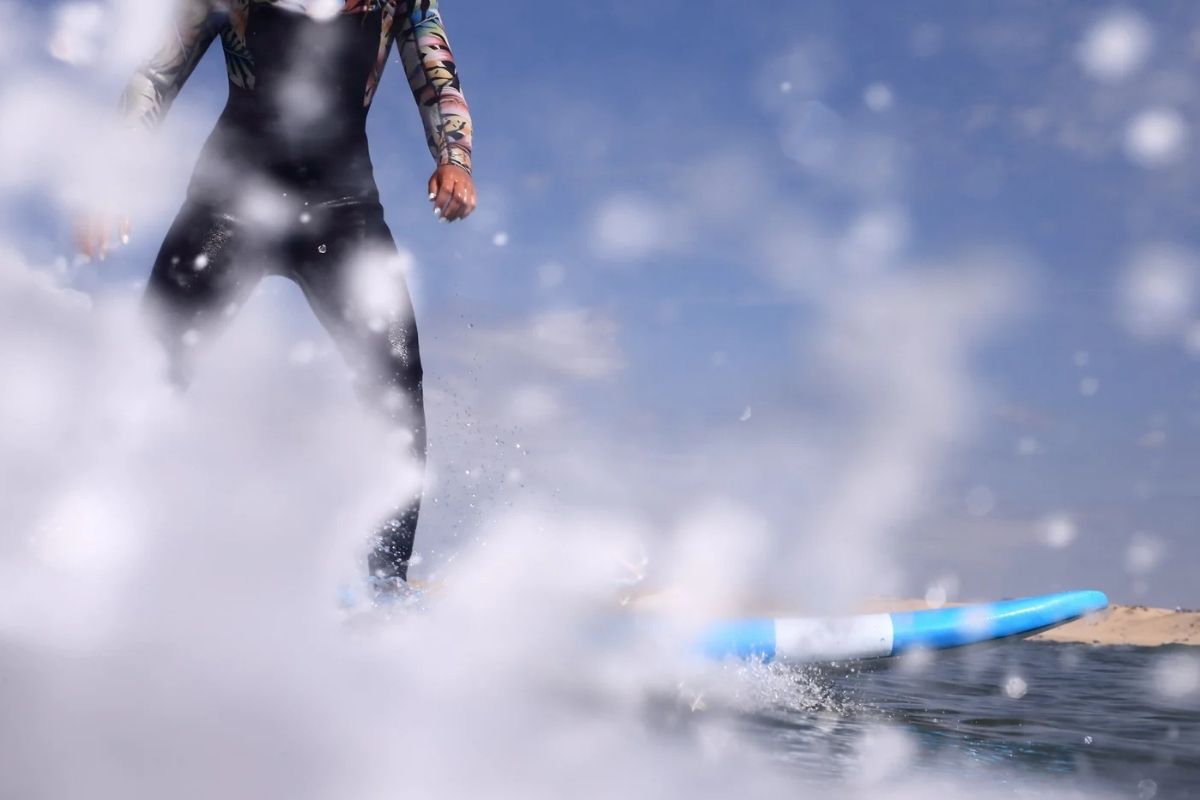





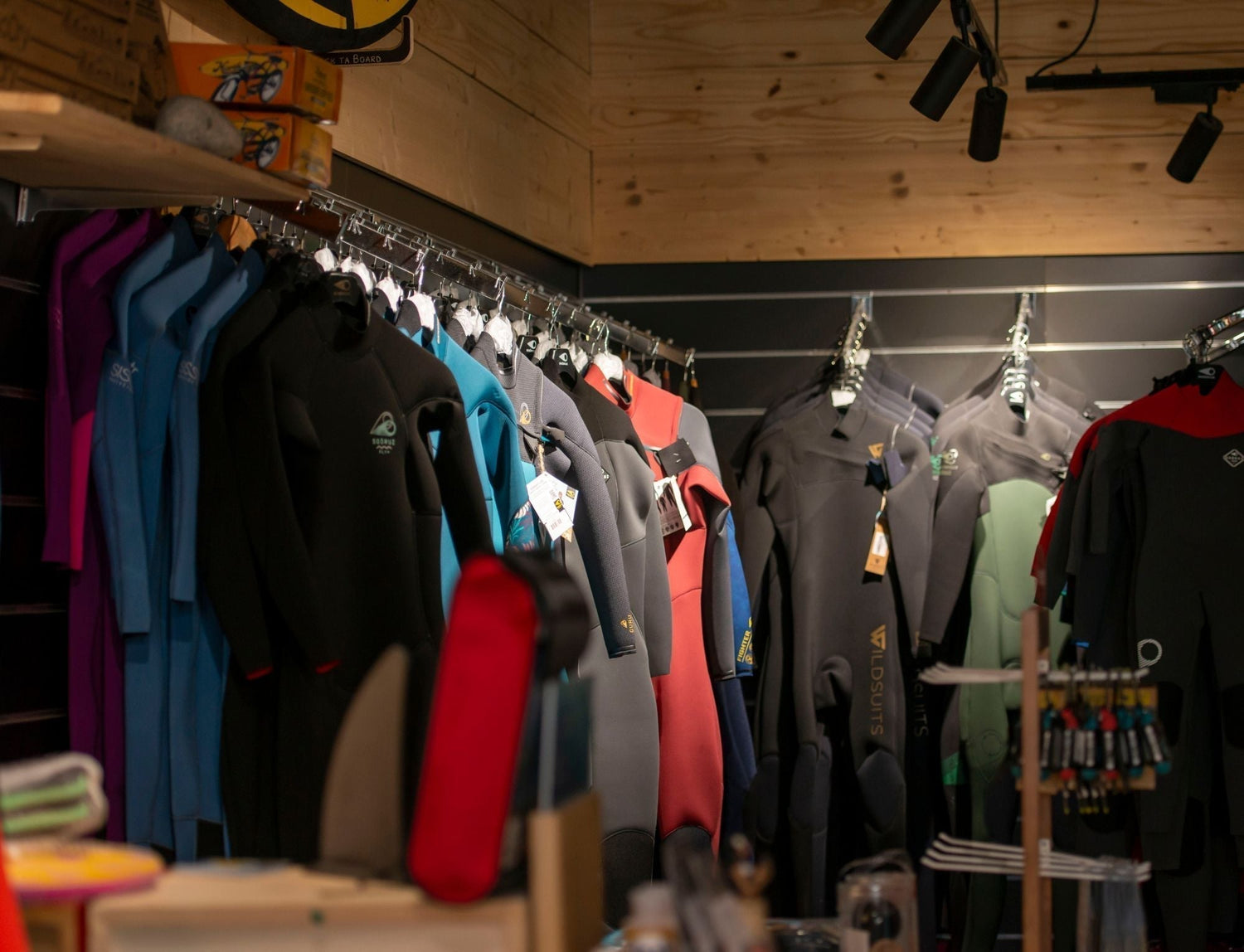
Not sure which wetsuit to pick? A 3/2mm covers 80% of sessions in France from May to October. In winter, switch to a 4/3mm or 5/4mm depending on your region. This guide walks you through how to choose the right thickness, size and type of surf wetsuit for your level and conditions.
The 3 key criteria:
- Thickness = water temperature -- this is the number one factor to avoid getting cold (or too hot)
- Size = perfect fit -- not too loose (water gets in), not too tight (discomfort and fatigue)
- Budget = between 100 and 400 EUR for a wetsuit that lasts 3 to 5 seasons with proper care
What wetsuit thickness should you choose for surfing?
Your wetsuit thickness depends directly on the water temperature. The colder the water, the thicker the neoprene needs to be to insulate you. The number before the slash (e.g. 4/3mm) refers to the torso, the number after to the arms and legs.
| Water temp. (C) | Thickness | Wetsuit type | Season | Accessories | Usage |
|---|---|---|---|---|---|
| 24 C+ | None or 1mm | Rash guard / boardshort | Summer (tropics) | None | Sun protection |
| 22-24 C | 1-2mm | Neoprene top | Summer Med/Corse | None | Light wind |
| 20-22 C | 2mm | Shorty / Spring suit | Summer Atlantic | None | Long sessions |
| 18-20 C | 2mm | Long-sleeve spring suit | Early summer | Optional: 2mm booties | Thermal comfort |
| 17-19 C | 3/2mm | Short-sleeve fullsuit | Shoulder season | Optional: 3mm booties | Versatility |
| 15-17 C | 3/2mm | Fullsuit | Spring/autumn | 3mm booties recommended | France standard |
| 13-15 C | 4/3mm | Fullsuit | Autumn/cold spring | 3mm booties | Atlantic shoulder season |
| 11-13 C | 4/3mm | Fullsuit | Mild winter | 3-5mm booties + optional gloves | Landes/Basque Country winter |
| 9-11 C | 5/4mm | Fullsuit + hood | Winter | 5mm booties + 3mm gloves | Bretagne/Vendee winter |
| 7-9 C | 5/4mm | Fullsuit + built-in hood | Cold winter | 5mm booties + 5mm gloves | Normandie/Manche winter |
| <7 C | 6/5mm | Fullsuit + built-in hood | Extreme cold | 7mm booties + 5mm gloves | Extreme conditions |
1-2mm wetsuits -- summer and warm waters (above 20 C)
Above 20 C, you don't need much neoprene. A 2mm shorty or a simple neoprene top is enough to stay comfortable for 1.5 hours in the water. The shorty protects your torso while leaving your arms and legs free: you keep full range of motion for paddling and popping up. In the Mediterranean from June to September, that's often all you need. On peak summer days, a UV rash guard does the job -- the goal is simply to protect your skin from the sun and board rash.
3/2mm wetsuits -- the versatile shoulder-season pick (15-20 C)
This is THE wetsuit for French surfers. The 3/2mm fullsuit covers the majority of sessions on the Atlantic coast between May and October, and year-round in the Mediterranean. With 3mm on the torso and 2mm on the arms and legs, it strikes a solid balance between warmth and flexibility. If you could only buy one surf wetsuit, this is it. The thinner neoprene on the limbs lets you paddle without tiring out, while the 3mm torso keeps your core warm. For most beginners surfing from May to October, the 3/2 is the ideal choice.
4/3mm wetsuits -- autumn, spring and mild winter (12-15 C)
When the water drops below 15 C, a 3/2 is no longer enough for sessions over an hour. The 4/3mm becomes essential. It's the transition wetsuit: warm enough for chilly October mornings on the Basque coast, flexible enough that you won't feel like a robot in the water. With a quality 4/3mm and 3mm booties, you can surf comfortably in the Landes all winter long. It also works for spring in Bretagne, when the water starts warming up but hasn't yet reached 15 C.
5/4mm wetsuits and thicker -- cold winter (below 12 C)
Below 12 C, welcome to 5/4mm territory. This is the quintessential winter surf wetsuit for Bretagne, Normandie and the Manche coast from November to March. The extra thickness makes a real difference when the water drops to 8-9 C. At this point, the wetsuit alone isn't enough: you'll need 5mm booties, 3 to 5mm gloves and a hood. Some models have a built-in hood, which eliminates water entry at the neck. Check out our complete guide to surfing in winter to prepare your cold-water sessions, from warm-up routines to choosing the right accessories.
Which wetsuit for your region in France?
France offers a unique diversity of conditions in Europe. Between the Manche at 8 C in January and the Mediterranean at 25 C in August, the range is enormous. The chart below gives you the recommended wetsuit thickness by region and season. These figures are based on average water temperatures -- always allow a margin if you run cold or plan longer sessions.
| Region | Reference spot | Winter (Jan-Feb) | Spring (Apr-May) | Summer (Jul-Aug) | Autumn (Oct-Nov) |
|---|---|---|---|---|---|
| Normandie / Manche | Etretat | 5/4mm + full | 4/3mm + booties | 3/2mm | 4/3mm |
| Bretagne Nord (north) | Saint-Malo | 5/4mm + full | 4/3mm + booties | 3/2mm | 4/3mm |
| Bretagne Sud (south) | Quiberon | 5/4mm + full | 4/3mm | 3/2mm | 3/2 or 4/3mm |
| Vendee / Charente | Les Sables | 5/4mm + booties | 4/3mm | 3/2mm | 3/2 or 4/3mm |
| Landes / Pays Basque | Hossegor | 4/3mm + booties | 3/2mm | Shorty or 2mm | 3/2mm |
| Mediterranee | Palavas | 3/2mm | 3/2mm | Shorty or none | Shorty or 2mm |
| Corse | Porto-Vecchio | 3/2mm | 2mm or shorty | None or shorty | Shorty |
+ full = hood + gloves + booties. Source: NOAA averages via seatemperature.org
Normandie / Manche -- This is the most demanding region in France when it comes to gear. The water rarely exceeds 17 C, even in August. In winter, it drops to 7-9 C: a 5/4mm with built-in hood, 5mm gloves and 5mm booties are non-negotiable. The upside? The waves are consistent and the lineups far less crowded than down south. Budget for accessories on top of your wetsuit.
Bretagne -- Two distinct vibes. The north coast (Saint-Malo, Finistere Nord) stays cold year-round with conditions similar to Normandie. Bretagne Sud (Quiberon, La Torche) is slightly milder: you can sometimes get away with a 3/2mm in October. Either way, a 4/3mm and a 5/4mm are must-haves in your wetsuit quiver if you surf year-round.
Landes / Pays Basque -- The French sweet spot. The water is noticeably warmer than further north: 12-13 C in winter, 20-22 C in summer. With a 3/2mm and a 4/3mm, you easily cover 10 out of 12 months. In peak summer, a shorty or a 2mm is enough for 2-hour sessions. This is the region where a single 3/2mm will carry you the furthest through the year.
Mediterranee / Corse -- The warmest waters in France: 14 C in winter, up to 26 C in summer. A 3/2mm handles winter with no issues, and from June to September you can surf in a shorty or even boardshorts on hot mistral days. The challenge here isn't the cold, but the swell: surf windows are less frequent, so when it fires, you want to be ready.
The different types of surf wetsuits
The fullsuit
The fullsuit covers your entire body, from ankles to wrists. It's the most versatile and most widely used wetsuit in France. It comes in various thicknesses (2mm to 6/5mm) to suit all temperatures. The fullsuit offers the best thermal protection thanks to its full coverage. It's the default choice for any session where the water is below 20 C. If you're a beginner and could only buy one type of wetsuit, the 3/2mm fullsuit is the one you need.
The shorty
The shorty has short sleeves and short legs (above the knee). It offers great freedom of movement while keeping your torso warm. It's the quintessential summer wetsuit, ideal when the water is between 18 and 22 C. You get protection from wind and board rash without overheating. The shorty is easy to put on and take off, which is a real plus when you're stacking sessions. Typical thickness: 2mm.
The Long John / Long Jane
The Long John (men) or Long Jane (women) is a sleeveless wetsuit with full-length legs. It protects the torso and legs well while leaving your arms completely free to paddle. It's a solid compromise between the shorty and the fullsuit for shoulder-season days when it's not cold enough for a fullsuit but too cool for a shorty. You'll see it mostly in stand-up paddle and coastal walking, but some surfers appreciate it in spring too.
The neoprene top and rash guard
The neoprene top (0.5 to 2mm) can be worn on its own or under a wetsuit for extra warmth. In tropical summers or in the Mediterranean, a neoprene top with boardshorts is more than enough. The rash guard provides no thermal insulation: its job is to protect your skin from the sun (UV) and chafing. If you surf in warm water (24 C+), a UV rash guard is often all you need. Pro tip: a thin thermal top under your wetsuit in winter can give you an extra 1 to 2 C of comfort.
How to choose the right wetsuit size
Fit is just as important as thickness. A wetsuit that's too loose lets cold water in and loses all its thermal efficiency. A wetsuit that's too tight compresses your ribcage, restricts your breathing and tires you out faster. The goal: a snug fit with no excess bunching that lets you raise your arms above your head without restriction.
To find your size, measure four key areas: chest (circumference under the armpits), waist (circumference at navel level), arms (shoulder to wrist, arm slightly bent) and legs (inseam to ankle). Compare your measurements with the size chart below. If you're between two sizes, go up if you're muscular, and go down if you're lean. Neoprene stretches slightly with use.
Men's size guide
| Size | Height (cm) | Weight (kg) | Chest (cm) | Waist (cm) | Arms (cm) | Legs (cm) |
|---|---|---|---|---|---|---|
| 3XL | 188-193 | 104-113 | 117-122 | 96-106 | 61 | 80 |
| 2XL | 188-193 | 95-104 | 112-117 | 91-96 | 61 | 80 |
| XL | 183-188 | 86-95 | 107-112 | 86-91 | 59 | 77 |
| L | 178-183 | 77-86 | 102-107 | 81-86 | 57 | 75 |
| M | 173-178 | 68-77 | 97-102 | 76-81 | 56 | 73 |
| S | 168-173 | 59-68 | 91-97 | 71-76 | 54 | 71 |
| XS | 163-168 | 54-59 | 86-91 | 66-71 | 52 | 69 |
| 2XS | 157-163 | 45-54 | 81-86 | 61-66 | 50 | 66 |
| 3XS | 152-157 | 41-45 | 76-81 | 56-61 | 48 | 63 |
| 4XS | 147-152 | 36-41 | 71-76 | 51-56 | 46 | 61 |
Women's size guide
| Size | Height (cm) | Chest (cm) | Waist (cm) | Arms (cm) | Thigh (cm) | Full arm (cm) | Legs (cm) |
|---|---|---|---|---|---|---|---|
| 2 | 145 | 71 | 58 | 85 | 45 | 46 | 63 |
| 4 | 155 | 78 | 61 | 86.5 | 48 | 48.4 | 66 |
| 6 | 160 | 82 | 65 | 89 | 50.5 | 50.8 | 68 |
| 8 | 165 | 87 | 69 | 91.4 | 53 | 53.2 | 69 |
| 10 | 170 | 92 | 73 | 93.8 | 55.6 | 55.6 | 70 |
| 12 | 172 | 97 | 77 | 96.2 | 58.2 | 58 | 71 |
| 14 | 174 | 103 | 82 | 98.6 | 60.8 | 60.4 | 72 |
My advice: always try on in-store if it's your first wetsuit. Sizes vary from brand to brand, and nothing beats trying it on to check there are no air pockets in the back or around the knees. If you're ordering online, measure yourself with a tape measure and compare with the brand's size chart.
Neoprene, seams and closures: the technologies that matter
Types of neoprene
Standard neoprene (petroleum-based) is found in most entry-level wetsuits. It gets the job done, but it's less flexible and less durable than the alternatives. Limestone neoprene (calcium carbonate-based) is lighter, more flexible and more resilient: it's the mid-range standard. Yulex (natural rubber) delivers the same performance as limestone with an 80% lower environmental impact -- you'll find it from Patagonia in particular. Graphene neoprene is the latest innovation: it distributes heat more evenly and dries faster. The price is still high, but the feedback is excellent.
Seams
Seams are the weak point of any wetsuit: that's where water gets in. Flatlock stitching is visible on both sides and lets a small amount of water through. It's fine for summer wetsuits (2mm and under). GBS (glued and blind stitched) seams don't go all the way through the neoprene: the needle enters and exits on the same side. The result: far fewer leaks. This is the standard for 3/2mm and above. High-end wetsuits add a reinforcement tape (liquid tape) on the inside of GBS seams for near-perfect watertightness.
Closure systems
The back zip is the easiest to get in and out of: you pull the zip and step in. It's the ideal choice for beginners. The downside: slight water entry at the neck. The chest zip offers better watertightness and more flexibility in the back, but it's trickier to put on. It's the standard for mid-range and high-end wetsuits. The zipless (no zipper) is the most watertight and the most flexible, but also the hardest to put on. It closes with a neoprene flap at the neck or chest.
My advice: for beginners, a back zip 3/2mm is the best value for money. You can get it on in 30 seconds, it covers the majority of sessions in France, and you'll find excellent models between 150 and 250 EUR. Switch to a chest zip when you start surfing regularly in winter or want more performance.
What budget for a surf wetsuit?
Expect to spend between 100 and 400 EUR for a quality surf wetsuit. The price depends on thickness, neoprene type, seams and closure. Good news: even entry-level wetsuits have made huge progress in recent years.
Entry-level (80-150 EUR) -- Standard neoprene, flatlock or basic GBS seams, back zip. Sufficient for beginners surfing in summer or shoulder season. Flexibility and durability will be lower than higher ranges, but the value is fair for a casual surfer (1-2 sessions per week).
Mid-range (150-300 EUR) -- Limestone neoprene, reinforced GBS seams, chest zip or improved back zip. This is the sweet spot: you get a flexible, watertight and durable wetsuit that will last 3 to 4 seasons. This is the price range where the comfort gain per euro spent is highest. The majority of regular surfers find what they need here.
High-end (300-500+ EUR) -- Premium limestone or Yulex neoprene, glued and welded seams, thermal lining, chest zip or zipless. These wetsuits are designed for dedicated surfers who spend 3 or more sessions per week in the water. The difference is most noticeable in flexibility, fast drying and warmth in winter conditions.
My advice: 150-250 EUR = the sweet spot for a wetsuit that lasts 3 seasons. Invest in the thickness you need for your region rather than technologies you won't benefit from as a beginner. And don't forget to budget for accessories: booties (30-60 EUR), gloves (25-50 EUR) and hood (25-45 EUR) if you surf in winter.
For a complete breakdown of the cost of getting into surfing, check out our article what budget to start surfing.
Tips to get the most out of your wetsuit
Putting on and taking off your wetsuit easily
Turn your wetsuit halfway inside out before putting it on: slide your legs in first, then pull the neoprene up over your torso. Use your palms, never your nails, to avoid tearing the neoprene. For chest zips, enter through the neck by widening the opening with both hands. A trick for cold days: fill a bucket with warm water and pour it into your wetsuit just before putting it on. Game changer. To take it off, reverse the process: unzip, free the shoulders, then roll the wetsuit down to the ankles.
Basic care
Wetsuit care is simple but essential for longevity. Rinse it with fresh water after every session to remove salt, sand and bacteria. Dry it in the shade, never in direct sunlight: UV rays degrade the neoprene and make it brittle. Store it flat or on a wide hanger (not a thin one that deforms the shoulders). Avoid leaving it folded or crumpled in your car boot for days. Once or twice a month, a soak in a neoprene-specific cleaning product eliminates odours.
For everything you need to know about care, check out our complete guide: the full guide to wetsuit care.
When to replace your wetsuit
With proper care, a quality wetsuit lasts 3 to 5 seasons. Here are the signs it's time for a new one: the neoprene loses its flexibility and becomes stiff, cracks appear on the surface, seams start to fail or let water through, you feel cold even though the thickness should be enough. If only one panel is damaged, a repair with neoprene glue can extend your wetsuit's life by a few months.
And to change comfortably after your session, check out our surf ponchos: practical for changing in the car park and warming up after getting out of the water.
Frequently asked questions
What thickness for surfing in Bretagne in winter?
In Bretagne, the water drops to 9-10 C in winter. A 5/4mm wetsuit with hood, gloves and booties is essential from November to March. Some local surfers even opt for a 6/5mm during the cold snaps of January-February.
What's the difference between a 4/3 and a 5/4?
The 4/3mm has 4mm on the torso and 3mm on the limbs, the 5/4mm has 5mm and 4mm. The 5/4 is warmer but slightly less flexible. Below 12 C, the 5/4 becomes necessary. Between 12 and 15 C, the 4/3 is enough for most surfers.
Do you need booties with a 4/3mm?
It depends on your region. In the Landes, 3mm booties are enough in winter with a 4/3. In Bretagne or Normandie, go for 5mm instead. Your feet are the first place you'll feel the cold, so don't skimp on booties. Check out our guide on how to choose your surf booties.
Can you use a surf wetsuit for other sports?
Yes, a surf wetsuit works for bodyboarding, stand-up paddle, kayaking or coastal walking. Only scuba diving requires a specific wetsuit (thicker and designed to withstand pressure). For kitesurfing or windsurfing, surf wetsuits work too, although some brands offer adapted cuts.
How long does a surf wetsuit last?
With proper care, a quality wetsuit lasts 3 to 5 seasons. The first signs of wear: loss of flexibility, neoprene crumbling, seams failing. An entry-level wetsuit used intensively will last closer to 2 seasons. Care (rinsing, drying in the shade) makes a huge difference in longevity.
What to wear under a surf wetsuit?
Most surfers wear nothing or a swimsuit. In winter, a thin thermal top under the wetsuit adds extra comfort and gives you an extra 1 to 2 C without adding bulk. Avoid cotton, which absorbs water. Go for a polyester or thin merino wool base layer.